
Cross-Border Mediation for Chinese-Australian Families, Estates and Family Businesses
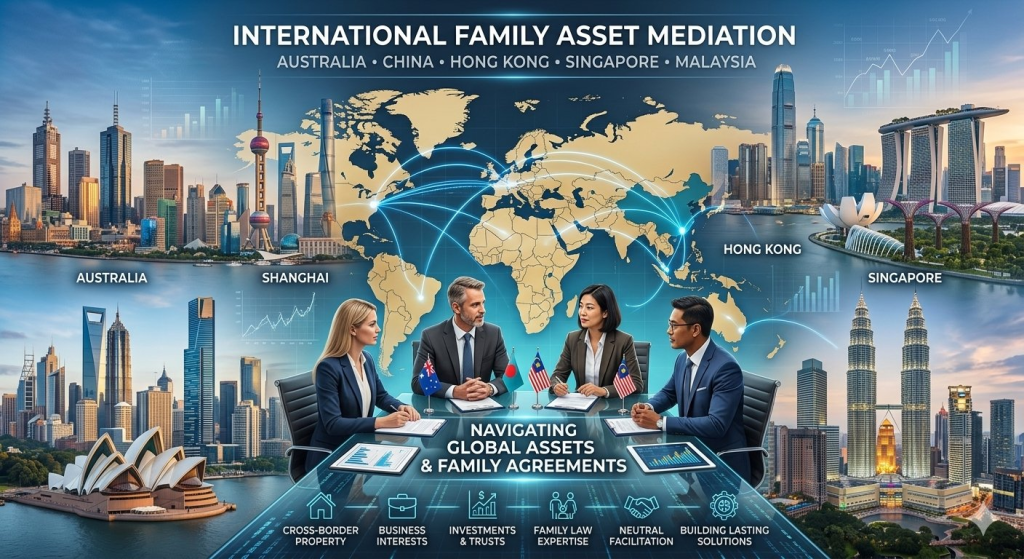
When a family’s assets, businesses and members are spread across Australia, China, Hong Kong, Singapore and Malaysia, an ordinary dispute stops behaving like an ordinary dispute. No single court has the whole picture. Orders made in one country may be difficult to enforce in another. Proceedings become public. And the people involved are not strangers, but they are parents and children, brothers and sisters, business partners of decades.
I am Justin Chua: an Australian solicitor, a Nationally Accredited Mediator and a Family Dispute Resolution Practitioner. I mediate directly in Mandarin and English, without an interpreter, and my practice is built around exactly these disputes, the ones that cross a border, a generation and a culture at the same time.
Arrange a confidential discussion — +61 3 9602 3988 · chuatan@tpg.com.au

Why these disputes are different
A dispute inside one Australian family, with one house and one bank account, is hard enough. Add a manufacturing business in Guangdong, an apartment in Hong Kong held in a nephew’s name, a Singapore holding company, a loan from a parent that was never documented because documenting it would have been an insult, and three siblings who now live on three continents, and litigation becomes a poor instrument.
Consider what a contested court proceeding actually delivers to a family in this position:
- It reaches only part of the property pool. An Australian court can make orders about Australian assets with confidence. What sits offshore is a far more complicated question, and often the practical answer is that the court cannot deliver it to you at all.
- It is public. Filed material and judgments can be read by competitors, by banks, by extended family and by the Chinese-language press. For families whose standing in a community is itself an asset, that cost is rarely recoverable.
- It runs for years and consumes the business. Directors stop making decisions. Banks grow nervous. Customers notice. The value in dispute shrinks while the dispute continues.
- It ends the relationships. At the end of a trial there is a winner, a loser, and a family that no longer speaks. In a family enterprise, that is not a side effect, it is the destruction of the thing being fought over.
Mediation answers each of those. It is private. It can deal with assets in every jurisdiction at once, because the parties are agreeing rather than asking a court to compel. It can be completed in weeks. And it leaves open the possibility that the family still functions afterwards.
The families and businesses I act for
My mediation practice is concentrated on matters where the amounts are significant, the structures are genuinely complex and discretion is not optional. In practice that means:
- First and second-generation Chinese-Australian families holding property, operating companies or investments in more than one country
- Family enterprises moving from the founder to the next generation, where the children have different skills, different levels of involvement and very different expectations
- Beneficiaries and executors of estates where the will, if there is one, deals with Australian assets but the family’s wealth is not confined to Australia
- Separating couples where one party, the assets, or both, are offshore
- Adult children and ageing parents negotiating care, accommodation, property transfers and inheritance while the parent is still living
- Business partners and investors in Australia–China ventures, offshore-funded property acquisitions, and lending arrangements between family members that were never reduced to writing
- Migration-linked investment and property held on trust, in a relative’s name, or through structures established for reasons that made sense at the time

What I am appointed to resolve
Family business succession and shareholder disputes
Who runs the enterprise. Who is paid and how much. Which child receives equity and which receives a property instead. What happens to the offshore operating entity, the Australian holding company and the family’s real estate. Whether a departing sibling is bought out, on what valuation and over what period. I am an Accredited Family Business Advisor as well as a mediator, and I read balance sheets, valuations and buy-out models without needing them explained.
Deceased estates, inheritance and family provision
Contested wills, family provision claims, disputes between executors and beneficiaries, testamentary and family trusts, and the very common situation where an estate holds Australian real property alongside assets in China, Hong Kong, Malaysia or Singapore that the Australian grant does not reach. Estate disputes settle at mediation far more often than they are decided at trial, and the earlier a family gets to the table, the more of the estate is left to divide.
Separation and divorce with assets in more than one country
Property in Australia and Asia, offshore income, businesses that support both households, and the difficult question of what a foreign asset is actually worth to the party who ends up with it. As a registered Family Dispute Resolution Practitioner I conduct family dispute resolution and issue Section 60I certificates. As a Family Law Arbitrator I can also determine a property or financial dispute where the parties want a binding outcome privately, rather than waiting for a hearing.
Elder disputes, care and intergenerational arrangements
Ageing parents, care and accommodation, “granny flat” and family arrangements, financial support flowing in both directions, property transferred to a child years ago on an understanding that was never written down, and inheritance expectations that the family has never spoken about openly. These matters are rarely really about money. They are about obligation, and about what was promised. I am a trained elder mediator and I conduct these matters in the language the parents are most comfortable in.
Commercial, property and contractual disputes
Shareholder and director disagreements, partnership breakdowns, joint ventures, business sale and purchase, commercial leasing, co-ownership and partition, construction and development disputes, guarantees, informal loans and debt recovery, including matters where one party or one asset sits offshore.
Parenting coordination and collaborative practice
Where parenting orders exist but the conflict has not stopped, I act as a Parenting Coordinator to manage the arrangement on an ongoing basis. Where a family wants to resolve matters without any threat of court, I act as a Collaborative Professional within that structured model.
Why parties choose me for these matters
I mediate in Chinese and in English, without an interpreter
Parties negotiate in their own language, at their own pace, and say what they actually mean. An interpreter changes a mediation, it slows the room, it flattens tone, and it makes a party self-conscious at precisely the moment they need to speak freely. It also means a third person hears everything. In a sensitive family matter, that alone can be the reason a party does not disclose what the settlement depends on.
I understand what is actually driving the position
Face. Filial obligation. The eldest son’s role and what happens when the capable child is not the eldest. The parent who will not say directly that they feel abandoned. An indirect “no” that an Australian mediator hears as “yes”. Money moved between family members over decades on trust rather than paper. I have studied or worked in China, Hong Kong, Singapore, Malaysia, Japan, Vietnam, Myanmar and India, and I read these dynamics in the room. Knowing why a party is refusing is usually the shortest path to the thing they will accept.
I am a practising litigator, not only a facilitator
I run my own litigation, including matters taken to contested hearings, and I have conducted cross-border litigation through to reported judgment. So when I tell a party what a refusal to settle is likely to cost them in money, time, evidence and risk, it is an assessment from someone who does the work, not a generality. Parties take that differently and it moves matters.
I read the financial material myself
A commerce degree with an accounting major, finance experience in Hong Kong before legal practice, a real estate agent’s licence and an agency I have operated, and businesses I have owned and carried the risk in. Valuations, comparable sales, income and yield analyses, company accounts and buy-out calculations do not need to be translated for me. Where two valuations diverge, I can usually identify whether the difference is method, assumption or comparables, and that is generally where the agreement is found.
Discretion is built into the process
Mediation is confidential and conducted without prejudice. Nothing is filed. There is no judgment to be reported, no listing for anyone to search and nothing for the Chinese-language media to pick up. For families whose reputation and business relationships are part of what is at stake, that is frequently the deciding factor.
One appointment, the full range of processes
Mediation, family dispute resolution with Section 60I certificates, family law arbitration, elder mediation, parenting coordination and collaborative practice. Few practitioners hold all of these. It means the process can be matched to your dispute — including changing process partway, where a facilitated negotiation needs to become a binding determination to finish.
Examples of the matters I handle
The following are illustrative composites. No identifying detail of any client or matter is disclosed.
A family enterprise passing to the second generation. A Melbourne import business built over thirty years, with a related manufacturing operation in China, three commercial properties in Victoria and four adult children. One child is running the business daily, one overseas and two uninvolved but expecting equal treatment. The founder wanted to retire without choosing publicly between his children. Mediated over three sessions: an equity structure for the child in the business, property to two others, a staged payment to the fourth, and a written family charter governing how future decisions would be made.
An estate spanning three jurisdictions. A widow and three adult children; a Melbourne home, a Hong Kong apartment, a Malaysian shophouse held in an uncle’s name and a substantial sum that had moved between family members over twenty years with no documentation. Two siblings had issued proceedings. Mediation dealt with all of the assets in one agreement, including the two that no Australian court could have reached, and the proceeding was discontinued.
Separation with offshore assets. An Australian family law property matter where the significant assets were a mainland business interest and an apartment held through a Singapore entity, and where each party’s valuation evidence was built on different assumptions. Resolved by identifying the real point of difference in the valuations, then structuring an outcome that gave one party the offshore interest and the other the Australian property with an adjusting payment.
An ageing parent and an undocumented promise. A mother who had transferred her home to one daughter in exchange for care that the other siblings said was never provided, and a family that had not discussed the subject in eight years. Mediated in Mandarin with the mother present and participating. The arrangement was restructured and documented, and the family provision claim that had been threatened was never issued.
How the process works
- Initial confidential discussion. A short conversation, in Mandarin or English, to understand the dispute, who needs to be at the table and whether mediation is the right process now. Nothing is disclosed to the other side.
- Appointment and agreement to mediate. Where both parties agree to proceed, terms of the mediation and fees are confirmed in writing. Where only one party has approached me, I can make the invitation to the other side in a way that does not read as an attack.
- Preliminary conferences. I meet each party separately before the mediation day. This is where most of the real work happens: the true barriers to settlement are identified, expectations are tested, and the necessary financial and legal material is assembled. Parties who do this arrive with a materially greater chance of resolving on the day.
- The mediation. In person at Level 2, 262 Queen Street, Melbourne, at a venue of your choosing, or online across time zones where family members are offshore. Conducted in the language the parties prefer.
- Documenting the outcome. Terms of settlement are recorded on the day. Where the matter is a family law property or parenting dispute, the documents needed to make the agreement binding follow. Where a matter does not resolve, I issue a Section 60I certificate where one is required.
Fees and engagement
Mediation is charged on a fixed, agreed basis, quoted in writing before anything commences, so that both parties know the cost of the process at the outset. Fees reflect the complexity of the matter, the number of parties, the volume of financial material to be read and whether preliminary conferences are held separately.
I am deliberately flexible on structure. Fees are commonly shared between the parties, and I am willing to work with the parties’ solicitors on a cost allocation that suits the matter. Where a mediation resolves in a day what litigation would have contested for two years, the fee is ordinarily a small fraction of one party’s costs of the first interlocutory step.
About Justin Chua
Justin Chua is a practising solicitor and principal of Chua Tan Associates, a Melbourne firm serving the Australian and Chinese-speaking communities since 1990, and a second-generation lawyer practising alongside his parents.
Accreditations and appointments
- Nationally Accredited Mediator — accredited October 2021 under the National Mediator Accreditation System, continuing under AMDRAS. Mediator Register Code QU3RR
- Family Dispute Resolution Practitioner — registered to conduct family dispute resolution and issue Section 60I certificates
- Family Law Arbitrator — appointed to arbitrate property and financial matters under the Family Law Act
- Parenting Coordinator
- Collaborative Professional
- Elder mediator — trained in elder mediation with anticipated specialist accreditation in elder mediation under AMDRAS
- Accredited Family Business Advisor — Family Business Association
- Licensed real estate agent
Mediation panels
AIFLAM · Law Society of New South Wales · Law Institute of Victoria · Legal Aid Western Australia · Legal Aid ACT · Legal Aid Queensland · Supreme Court of the Northern Territory · Brisbane Mediations · Land Court of Queensland
Languages: English, Mandarin
Available: Australia-wide, in person and online. Melbourne, Sydney, Brisbane, Perth, Adelaide, Canberra, Darwin and regionally.
跨境调解服务 — 澳洲、中国及亚洲家族事务
当家族的资产与亲人分布在不同国家
我是 Justin Chua(蔡律师),澳洲执业律师、澳洲国家认可调解员(Nationally Accredited Mediator)、家事纠纷调解从业人员(FDRP)及家事法仲裁员。我以中文及英文直接主持调解,无需翻译.
当一个家族的房产、公司、投资与家庭成员分布在澳洲、中国大陆、香港、新加坡及马来西亚时,普通的诉讼程序往往无法解决问题:澳洲法院对境外资产的处理能力有限,诉讼材料与判决会公开,程序动辄数年,家族关系与企业价值在诉讼期间不断损耗。
调解则不同 — 全程保密、不留公开记录、可以在同一份协议中一并处理各个法域的资产,通常数周内即可完成。
我处理的案件类型
- 家族企业传承与股东纠纷 — 接班安排、股权分配、退出股东的估值与买断、境内外公司架构的处理
- 遗产与继承纠纷 — 遗嘱争议、家庭供养申请(family provision claim)、遗嘱执行人与受益人之间的争议、跨境遗产(澳洲遗产认证无法触及的境外资产)
- 离婚与财产分割 — 一方或资产在境外的家事财产纠纷、境外企业与房产的估值分歧,并可签发 Section 60I 证明书
- 长者与代际纠纷 — 赡养与居住安排、房产过户后的争议、口头承诺与”没有写下来”的家庭约定、继承期待
- 商业、房地产与合约纠纷 — 合伙解散、合资纠纷、商业租赁、共有物分割、民间借贷与担保、跨境投资纠纷
为什么选择我
- 中英双语直接主持 — 当事人以自己的语言谈判,无第三方翻译在场,保密性更高
- 理解华人家族的真正症结 — 面子、孝道、长子责任、未立字据的家族借贷、间接表达的拒绝。我曾在中国大陆、香港、新加坡、马来西亚、日本、越南、缅甸及印度学习或工作
- 执业诉讼律师 — 本人办理诉讼案件,包括维多利亚州最高法院的审理案件及已公开判决的跨境诉讼,能准确评估不和解的实际代价
- 财务与商业背景 — 商学士(会计专业)、香港金融从业经历、持牌房地产经纪并曾经营地产代理公司,可直接审阅估值报告与公司账目
- 绝对保密 — 调解全程保密,不立案、不公开、无判决记录
Contact Us
电话 +61 3 9602 3988 · 电邮 chuatan@tpg.com.au · 微信 chuatan262 地址:Level 2, 262 Queen Street, Melbourne VIC 3000 全澳服务,可线上进行(可配合中国、香港、新加坡时区)。首次沟通不收费。
Frequently asked questions
Can a mediated settlement deal with assets in China, Hong Kong or Singapore?
In substance, yes and this is the principal reason families in this position mediate. A court’s power over assets outside its jurisdiction is limited and enforcement offshore is a separate exercise with its own cost and uncertainty. A mediated agreement works differently: the parties agree, so every asset can be brought into one settlement regardless of where it sits. How that agreement is then documented and secured depends on the jurisdictions involved, and it is something to work through at the outset rather than at the end.
Do the parties need to be in Australia?
No. A substantial part of my practice is conducted online with parties in China, Hong Kong, Singapore, Malaysia and elsewhere, scheduled around the relevant time zones. Family members offshore can participate fully. Where it matters that people are in the room together, I conduct mediations in person in Melbourne and travel interstate for listed matters.
Is mediation confidential?
Yes. Mediation is conducted on a without prejudice basis and what is said in the process generally cannot be used later in court. Nothing is filed, there is no public listing and there is no judgment. For families whose commercial standing and community reputation form part of what is at stake, this is often the decisive advantage over litigation.
Do we need lawyers to mediate?
Not necessarily, and many mediations proceed without them. That said, in matters involving substantial assets, company structures or cross-border elements, parties are generally better served having their own solicitor advising them. My role is to be neutral, and I cannot advise either party. Where parties are unrepresented, I structure the process so that neither side is disadvantaged by that.
What if one family member refuses to take part?
That is common at the start and less often fatal than it appears. An invitation to mediate that comes from a neutral, in the other party’s own language, and framed as a way of protecting the family and the business rather than as an escalation, is answered very differently from a letter of demand. Where a party genuinely will not participate in a family law matter, I can issue the Section 60I certificate required to proceed.
Can you mediate if proceedings have already started?
Yes. Many matters come to me after litigation has been commenced, and courts routinely expect the parties to attempt mediation. Starting earlier simply leaves more of the asset intact, but a matter already on foot can still be resolved and discontinued.
What is the difference between mediation, family dispute resolution and arbitration?
Mediation is a facilitated negotiation: I help the parties reach their own agreement and I do not decide anything. Family dispute resolution is the statutory form of that process for family law matters, and only a registered practitioner can conduct it and issue a Section 60I certificate. Arbitration is different again, the parties authorise me to make a binding determination of a property or financial dispute, privately and far sooner than a contested hearing. I am appointed in all three, so the process can be matched to the dispute.
How long does it take?
Most matters are mediated within four to eight weeks of appointment, including preliminary conferences with each party. The mediation itself is commonly a single day, and complex multi-party or multi-jurisdiction matters sometimes run over two or three sessions. Compared with a contested proceeding, the process is measured in weeks rather than years.
Speak with me confidentially
If a dispute in your family or your family’s business has reached the point where people have stopped speaking directly to one another, the earlier you act, the more options remain. Very little is lost by a confidential conversation, and a great deal is usually lost by waiting.
Justin Chua — Nationally Accredited Mediator · Family Dispute Resolution Practitioner · Family Law Arbitrator · Solicitor
Chua Tan Associates · Level 2, 262 Queen Street, Melbourne VIC 3000 Telephone +61 3 9602 3988 · Mobile 0412 656 151 Email chuatan@tpg.com.au - WeChat chuatan262
Enquiries in English or Mandarin. Initial discussion with charge. Available Australia-wide, in person and online.
 简体中文
简体中文  English (Australia)